Manufacturing — about the project
A heavy manufacturing operation running three plants on continuous shift patterns needed a way for line workers, machine operators, and contracted maintenance staff to raise safety, harassment, and welfare concerns without going through a supervisor, and without leaving the shop floor.
Sector
Manufacturing
Workforce
≈ 6,500 across 3 plants
The complaint box on the wall was empty, the suggestion form was a paper slip, and the only way to escalate was to ask the supervisor whose shift you were complaining about.
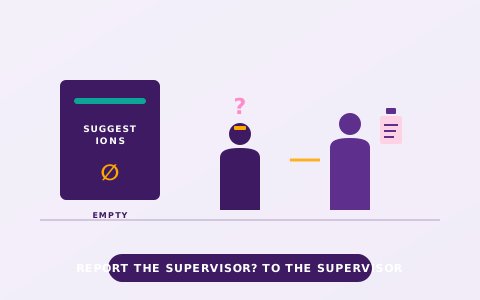
Floor culture meant nobody used the box. Shift handovers happened in the same room as the supervisor. Safety incidents like minor near misses, ergonomic hazards, and even harassment went unreported until they compounded into something a regulator or a union rep would notice. The HR team operating from the corporate office had no realtime view of plant level conditions and learned about incidents from the same channel as everyone else: rumour.
Tablet kiosks in welfare rooms. Voice first intake. Escalation rules that bypass the line.
açai Hear was deployed on tablet kiosks placed in plant welfare rooms, physically separate from the production floor, accessible during meal and break periods, with no login and no camera. Workers could file in voice (in their working language) and the AI counsellor surfaced clarifying questions without ever requiring identity disclosure.
Routing rules treated supervisor named cases as automatic escalations to the plant HR head, with the supervisor explicitly excluded from the case visibility list. Safety tagged cases routed in parallel to the EHS function with a 4 hour SLA. The production manager saw aggregate, identity stripped trend data, enough to act on patterns and not enough to retaliate.
Median incident-to-action time on the shop floor dropped from days to hours.
Plant level safety reporting volume increased 4.1× in the first six months, entirely because the channel was usable. Median incident to first action time fell from 38 hours to 20 hours, a 47% reduction. The EHS team caught two ergonomic hazards (one on a press line, one in a packing bay) early enough that no time loss injury occurred.
Union representatives were given read access to aggregated trend data, which materially improved the working relationship with management. The plant heads reported that the audit trail (case files, attachments, decisions, SLA evidence) was the single most useful change in their compliance posture in years.